


If you’ve been running Amazon PPC campaigns for a while, you’ve probably hit this wall: you know which ads get clicks and which get sales, but you have no idea what happens in between.
Did someone see your Sponsored Brand ad, then come back three days later through a Sponsored Product ad before finally buying? Did your display ad actually influence that sale, even though it didn’t get the “last click” credit?
Without knowing the full journey your customers take, you’re basically flying blind and probably wasting a ton of money on ads that are actually working but not getting credit for it.
That’s exactly why Amazon built the Amazon Marketing Cloud, or AMC as everyone calls it. And if you’re serious about understanding your ad performance from top to bottom, this is the tool you need to master.
Let me show you exactly how to use AMC to track your full funnel ad performance, and more importantly, how to actually make money from the insights it gives you.
What Is Amazon Marketing Cloud (AMC)?

Let’s start with the basics because there’s a lot of confusion about what Amazon AMC actually is.
Amazon Marketing Cloud is Amazon’s advanced analytics platform that lets you analyze your advertising data across the entire customer journey. Think of it as the “behind the scenes” view of how your ads really perform.
Here’s what makes AMC different from your regular campaign reports in Seller Central:
- It tracks customers across multiple touchpoints (not just the last click)
- It combines data from Sponsored Products, Sponsored Brands, Sponsored Display, DSP, and even external traffic
- It shows you the actual path customers take before buying
- It uses privacy-safe, aggregated data, so you’re not tracking individual people
In simple terms, regular Amazon reports tell you “this ad got a sale.” AMC tells you, “This customer saw 4 different ads over 8 days before buying, and here’s exactly which ads influenced that decision.”
That’s a game-changer for understanding what’s actually working.
AMC Services Meaning: What Can You Actually Do With It?
When people talk about AMC services meaning, they’re usually referring to the suite of analytics capabilities that AMC provides. Let me break down what you can actually do with this platform.
Track Your Complete Amazon PPC Funnel
Your Amazon PPC funnel isn’t a straight line, it’s messy. Customers see your ad, maybe they click, maybe they don’t. They browse around, look at competitors, come back later, see another one of your ads, and finally buy.
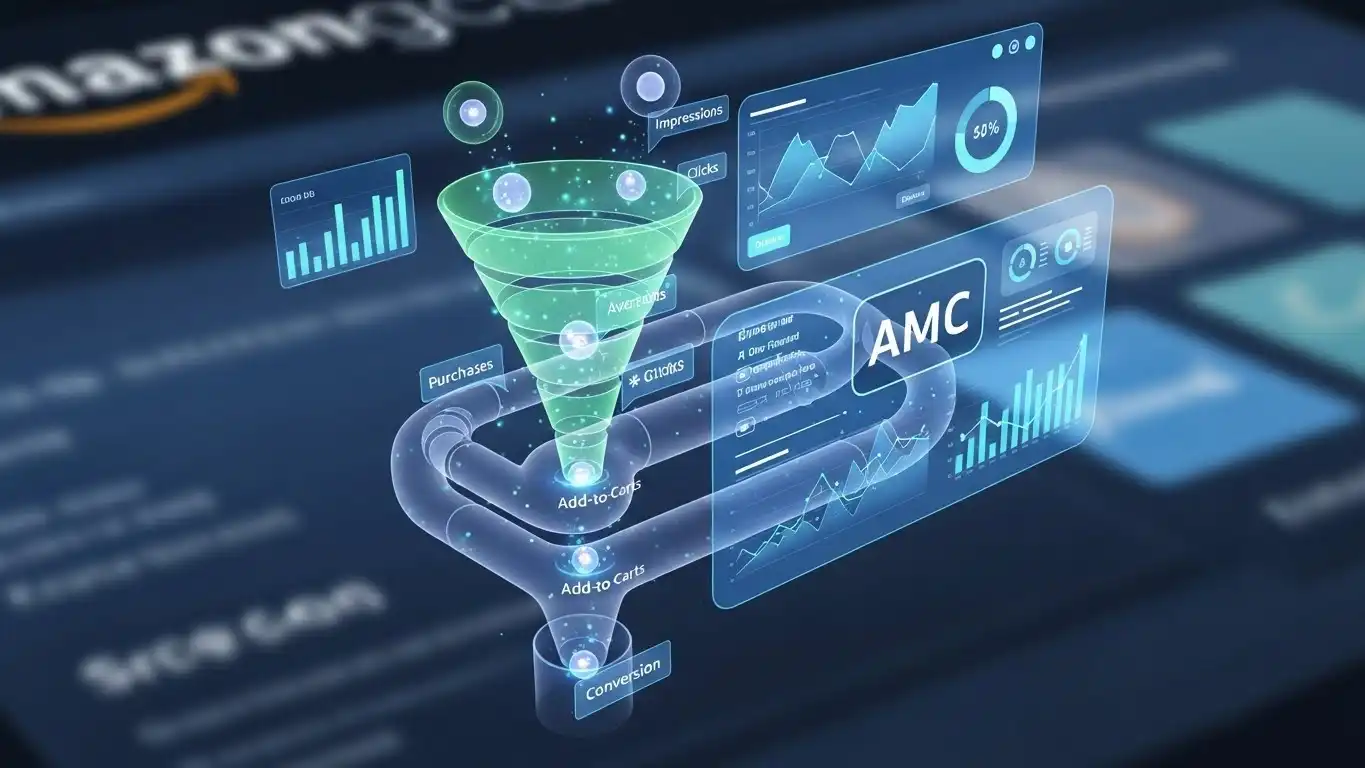
AMC shows you this entire funnel:
- Top of funnel: How many people are seeing your ads
- Middle of funnel: How many are engaging, clicking, viewing your products
- Bottom of funnel: How many are actually converting
But more importantly, it shows you how these stages connect. You’ll see that some ads are amazing at introducing people to your brand (even if they don’t convert immediately), while others are great at closing the deal.
Understand Cross-Channel Attribution
This is where AMC really shines. Let’s say you’re running:
- Sponsored Product campaigns
- Sponsored Brand campaigns
- Amazon DSP display ads
- Maybe even sending external traffic from Google or Facebook
Regular reporting gives credit to whichever ad got the last click. That’s like giving the basketball player who scored the final basket credit for the entire game, ignoring all the assists and defense that made it possible.
AMC uses Amazon using interactive marketing data to show you how all your channels work together. You’ll discover that your DSP ads might not directly drive sales, but customers who see them are 3x more likely to convert when they later see your Sponsored Product ad.
Suddenly, that DSP campaign you were about to cancel? It’s actually a critical part of your funnel.
How to Get Access to Amazon Marketing Cloud
Alright, so you’re sold on AMC. Now the question everyone asks: how to get access to Amazon Marketing Cloud?
Here’s the reality, and it’s not what most sellers want to hear.
AMC Access Requirements
Amazon doesn’t just hand out AMC access to everyone. There are specific requirements:
Direct Access Requirements:
- You need to be enrolled in the Amazon Brand Registry.
- You must have a significant advertising spend (Amazon doesn’t publish the exact threshold, but think $50,000+ annually).
- You need technical capabilities to write SQL queries (yes, really).
Alternative Access Options:
If you don’t meet those requirements, you have three options:
- Work with an Amazon Ads partner who has AMC access and can run reports for you
- Use a managed service that provides AMC insights without you needing direct access
- Wait until your ad spend grows, and then apply for access through your Amazon Ads account manager
Most small to mid-size sellers use option #1, working with an agency or consultant who already has AMC access.
Amazon AMC Login Process
Once you have access approved, the Amazon AMC login process is straightforward:
- Log in to your Amazon Ads console (advertising.amazon.com)
- Look for “Amazon Marketing Cloud” in your left navigation menu
- Accept the AMC terms and conditions
- Create your first AMC instance (this is basically your data workspace)
If you don’t see AMC in your navigation, you don’t have access yet and need to request it through your account manager or partner.
Is Amazon Marketing Cloud Free?
Let’s talk money because this is usually the next question: Is Amazon Marketing Cloud free?
The platform itself is technically free to access; Amazon doesn’t charge you a subscription fee to use AMC.
However (and this is a big however), using AMC effectively costs money in several ways:
The Real Costs of Using AMC:
- Minimum Ad Spend Requirements: You need to maintain a certain advertising spend to keep access. If your spending drops too low, Amazon may revoke your access.
- Technical Resources AMC requires SQL query knowledge. You’ll either need to:
- Learn SQL yourself (time investment).
- Hire someone who knows SQL ($50-150/hour).
- Pay an agency to run queries for you ($500-5,000/month, depending on complexity).
- Data Storage and Processing. While basic AMC is free, AMC paid features are only available to customers who sell in the Amazon store and have substantial advertising investment. Advanced features and higher data processing limits may require additional Amazon spending.
So while the platform is “free,” actually using it effectively requires investment. Think of it like getting a free gym membership. Sure, the membership is free, but you still need to buy workout clothes, pay for gas to get there, and invest time to actually use it.
Amazon Marketing Cloud Documentation: Getting Started
When you first log into AMC, you’ll want to reference the Amazon Marketing Cloud documentation. Amazon provides pretty comprehensive guides, but I’ll give you the practical version of what you need to know.
Understanding AMC Data Structure
AMC organizes data into tables. The main ones you’ll use are:
- Impressions: When your ads were shown
- Clicks: When people clicked your ads
- Conversions: When people bought
- Attributed events: Connections between ads and actions
Each table has dozens of fields (campaign name, ASIN, timestamp, cost, etc.). Your SQL queries pull specific data from these tables based on what you want to analyze.
Your First AMC Query
Don’t worry, I’m not going to make you learn SQL right now. But here’s what a simple query looks like:
You tell AMC: “Show me everyone who saw my Sponsored Brand ad, then clicked a Sponsored Product ad within 7 days, and how many of them bought.”
AMC runs the query and gives you a report. That report might show you that 23% of people who follow that exact path end up buying, compared to only 8% who only see one ad type.
Now you know: running Sponsored Brand and Sponsored Product campaigns together is way more effective than running them separately.
Amazon Marketing Cloud API
For advanced users, the Amazon Marketing Cloud API lets you automate queries and integrate AMC data with your other tools. This is useful if you:
- Want to run the same reports automatically every week
- Need to combine AMC data with your inventory or financial systems
- Are you managing multiple brands and want consolidated reporting
Most sellers won’t need the API initially, but it’s there when you’re ready to scale up.
Amazon Marketing Cloud Audiences: Building Better Targeting

One of the most powerful features of AMC is creating custom audiences. Amazon Marketing Cloud audiences let you segment customers based on their actual behavior across your entire ad funnel.
How AMC Audiences Work
Traditional Amazon advertising lets you target by keywords, products, categories, and some basic demographics. That’s fine, but it’s pretty blunt.
AMC audiences let you create laser-focused segments like:
- “People who viewed my product page three times but never bought.”
- “Customers who bought from me once but haven’t returned in 60 days”
- “People who clicked my ads but bought a competitor’s product”
- “Shoppers who engage with my brand content but have low purchase intent”
You create these audiences in AMC, then push them to your DSP campaigns for incredibly precise targeting.
Real-World Audience Examples
Let me give you some practical examples:
Example 1: The Window Shopper Audience You discover through AMC that people who view your product page 2-3 times within 14 days have a 45% conversion rate, but only if they see a retargeting ad during that window.
You create an AMC audience of 2-3 page viewers within 14 days and serve them targeted DSP ads with a special offer. Your conversion rate on that audience jumps from 45% to 68%.
Example 2: The Cross-Sell Opportunity AMC shows you that customers who buy Product A often view Product B’s page but don’t buy. You create an audience of “Product A purchasers who viewed Product B” and serve them a bundle offer through DSP ads. Boom, you just increased customer lifetime value.
Example 3: The Competitor Conquesting Audience You identify through AMC that customers who view competitor products often also view yours. You create an audience of “competitor viewers” and aggressively retarget them with your unique selling points.
This level of targeting was impossible before AMC. Now it’s table stakes for sophisticated sellers.
Amazon PPC Audit: Using AMC Insights
Let’s talk about how AMC transforms the way you do an Amazon PPC audit. Traditional audits look at campaign structure, keyword selection, and basic metrics. AMC takes it to another level.
Full Funnel Amazon PPC Account Audit
When you run an Amazon PPC account audit with AMC data, you can answer questions like:
Question 1: Are my campaigns working together or competing? AMC will show you if your Sponsored Product and Sponsored Brand campaigns are complementing each other or if they’re just bidding against each other for the same clicks.
Question 2: What’s my real customer acquisition cost? Instead of looking at individual campaign ACOS, you can see the total advertising investment required to acquire a customer across all touchpoints. You might discover your “break-even” Sponsored Product campaign is actually profitable when you see it’s the final step in a multi-touch journey.
Question 3: Which touchpoints can I cut without hurting performance? This is huge for budget optimization. AMC might show you that customers who see 4+ ads before buying have the same conversion rate as those who see 2 ads. That means you can reduce frequency and save money without losing sales.
Question 4: Where are people dropping out of my funnel? You can identify exactly where you’re losing potential customers. Is it after the first ad impression? After clicking but not viewing the product? After viewing but not adding to the cart? Each leak needs a different fix.
Amazon Ad Funnel Optimization:
Your Amazon ad funnel should look something like this:
- Awareness: Shoppers see your brand for the first time.
- Consideration: They engage with your content, view products.
- Decision: They compare you to competitors.
- Purchase: They buy.
- Loyalty: They come back and buy again.
AMC shows you exactly how many people are at each stage and where they’re getting stuck. Then you can optimize each part:
- Top of funnel (awareness): Increase Sponsored Brand and DSP impression share
- Middle of funnel (consideration): Improve product detail pages, A+ content
- Bottom of funnel (purchase): Optimize pricing, offers, conversion elements
- Post-purchase (loyalty): Use audiences to bring people back
Amazon PPC Automation Campaign with AMC Data
Here’s where things get really interesting: combining AMC insights with Amazon PPC automation campaign strategies.
AMC tells you what’s working, and automation executes on those insights at scale.
Automated Bidding Based on Funnel Position
Let’s say AMC shows you that customers who are seeing your ads for the first time need 3-4 impressions before they click, but customers who’ve seen your brand before convert on the first click.
You can set up automated rules:
- New-to-brand traffic: Lower bids, focus on impressions
- Retargeting traffic: Higher bids, focus on conversions
Your Amazon PPC automation campaign adjusts bids automatically based on where the customer is in the funnel.
Dynamic Budget Allocation
AMC might reveal that Wednesday afternoons have a 3x higher conversion rate for customers who’ve seen two previous ads. Your automation can automatically increase budget during those time windows for those specific audience segments.
This level of sophistication used to require a full-time team. Now it’s automated based on AMC data.
What AMC Teaches You
Lesson 1: Attribution Is Everything
Stop judging campaigns by last-click attribution alone. AMC teaches you to think about assisted conversions, view-through conversions, and multi-touch attribution.
Lesson 2: Customer Journey Matters More Than Individual Ads
Your best-performing campaign might be the one that introduces people to your brand, not the one that gets the final sale. AMC shows you how to value every touchpoint appropriately.
Lesson 3: Data-Driven Decisions Beat Gut Instinct
Before AMC, you’d make decisions based on limited data and experience. With AMC (Amazon Marketing Cloud), you stop guessing.
You see exactly how real customers move:
- Who saw your ad → added to cart → bought something else → came back a week later
- Which ads bring new buyers vs repeat buyers
- What people buy together across thousands of orders
It’s like having a crystal ball built from real shopping data. Every decision you make after that actually works, because it’s based on facts, not hunches.
Lesson 4: Integration Beats Isolation:
Running campaigns in silos is inefficient. AMC shows you that integrated, full-funnel strategies outperform disconnected campaigns every single time.
What AMC Experts Provide?
Professional AMC services typically include:
- Query Writing and Analysis: They handle the SQL queries and translate the data into actionable insights you can understand.
- Custom Dashboard Creation Instead of running one-off queries, they build dashboards that automatically update with your key metrics.
- Audience Creation and Management. They identify high-value audiences, create them in AMC, and push them to your campaigns.
- Full Funnel Strategy Development. They use AMC insights to redesign your entire advertising approach for maximum efficiency.
- Ongoing Optimization They continually monitor AMC data and adjust campaigns based on what they discover.
When to Hire AMC Help vs. DIY
Hire help if:
- Your ad spend is over $50,000/year and growing
- You don’t have SQL or data analysis skills in-house
- You need advanced attribution modeling
- You’re running complex multi-channel campaigns
Do it yourself if:
- You have technical capabilities and time
- Your advertising is relatively simple (just Sponsored Products, for example)
- You want to learn the platform before scaling
- Budget is tight, and you can invest time instead of money
Understanding AMC Marketing and the AMC Cloud Infrastructure
Let’s talk briefly about the technical side: AMC marketing runs on the AMC cloud infrastructure, which is built on Amazon Web Services (AWS).
Why does this matter? Because it means:
- Your data is secure and privacy-compliant. Amazon uses aggregated, anonymized data. You’re not tracking individual users; you’re seeing patterns across groups of users.
- Processing power is massive. The AMC can analyze billions of data points quickly. Queries that would take days on a regular computer run in seconds on AMC.
- Storage is virtually unlimited. You can store years of advertising data without worrying about running out of space or slowing down performance.
- Integration is seamless because it’s all Amazon infrastructure. AMC connects natively with your ad accounts, Seller Central, and other Amazon tools.
You don’t need to understand AWS to use AMC, but knowing it runs on enterprise-grade infrastructure helps explain why it’s so powerful.
Amazon Marketing Cloud Logo and Branding: What You’ll See
When you log into AMC, you’ll see the Amazon Marketing Cloud logo it is part of the Amazon Ads suite of tools. This branding consistency means:
- It’s an official Amazon product (not third-party)
- It follows Amazon’s security and privacy standards
- Updates and features are regularly released
- Support is available through Amazon Ads
The interface looks similar to other Amazon Ads tools, so if you’re familiar with Campaign Manager or DSP, you’ll recognize the layout and navigation.
AMC Amazon: Real-World Performance Tracking Examples
Let me show you some real examples of how sellers use AMC Amazon to track full funnel performance.
Example 1: The Health Supplement Brand
A supplement seller was spending $100K/month on advertising across Sponsored Products, Sponsored Brands, and DSP. They thought their DSP campaigns were failing because the direct ROAS was only 1.5.
AMC revealed:
- Customers who saw DSP ads were 4x more likely to convert on Sponsored Product ads within 30 days
- The “true” ROAS when accounting for assisted conversions was actually 5.2
- DSP was their most profitable channel, not their worst
They increased DSP budget by 50% and total sales jumped 34% with better overall efficiency.
Example 2: The Kitchen Gadget Seller
A kitchen tools brand had 15 different products and couldn’t figure out which advertising strategy worked best for each.
AMC analysis showed:
- High-ticket items ($50+) needed 5+ touchpoints before purchase.
- Low-ticket items ($15-25) converted on 1-2 touchpoints.
- Cross-sells happened most often 14-21 days after the first purchase.
They created three different funnel strategies based on price point and increased overall ROAS from 3.2 to 4.8.
Example 3: The Beauty Brand Launch
A new beauty brand wanted to launch on Amazon but had a limited budget. They used AMC to:
- Identify which competitor customers were most likely to switch
- Create lookalike audiences based on those switchers
- Build a funnel that maximizes efficiency at each stage
Result: They achieved profitability in month 3 instead of the typical 6-12 months for new brands.
5 Critical AMC Reports Every Seller Should Run
Let me give you five specific reports you should be running regularly with Amazon Marketing Cloud.
Report 1: Multi-Touch Attribution Report
What it shows: All the touchpoints a customer experienced before converting.
Why it matters: You’ll see which ads are assisting sales, not just getting last-click credit. Action: Adjust budgets to properly fund campaigns that assist conversions
Report 2: New-to-Brand Analysis
What it shows: How many of your sales are from brand-new customers vs. repeat buyers. Why it matters: New customer acquisition is more valuable than repeat sales for growth. Action: Invest more in campaigns that efficiently bring in new customers
Report 3: Cross-Device Journey Report
What it shows: How customers interact with your ads across desktop, mobile, and tablet. Why it matters: Customers often research on mobile and buy on desktop (or vice versa.) Action: Optimize your funnel for cross-device behavior
Report 4: Time-to-Conversion Analysis
What it shows: How long it takes from first impression to final purchase.
Why it matters: Helps you set proper attribution windows and budget pacing.
Action: Adjust your campaign settings based on actual customer decision timelines.
Report 5: Audience Overlap Report:
What it shows: Which of your campaigns are reaching the same people?
Why it matters: Prevents you from competing against yourself and wasting money.
Action: Refine targeting to reduce overlap and expand total reach.
Common AMC Mistakes to Avoid
Before we wrap up, let me warn you about the most common mistakes sellers make with AMC.
Mistake #1: Analysis Paralysis
AMC provides so much data that it’s easy to get overwhelmed and do nothing. Start with one simple question, get an answer, make a change, measure results. Then move to the next question.
Mistake #2: Ignoring Privacy Requirements
AMC requires minimum audience sizes (typically 100+ users) to protect privacy. Don’t try to create super-narrow segments that violate these thresholds.
Mistake #3: Treating Reports Like Museum Pieces
You pull beautiful data, nod at the pretty charts, maybe even screenshot it for the team chat, and then everything stays the same. That report didn’t cost you time and money to become wall art. It’s a to-do list in disguise. If the numbers say your top keyword has 8 % conversion and another has 1 %, kill the 1 % one today. If new-to-brand buyers only come from TikTok ads, double the budget there tomorrow. Data without decisions is just expensive nostalgia. Act on one insight this week, and you’ll make more profit than 99 % of sellers who “analyze” all year.
Mistake #4: Expecting Instant Results
AMC insights often require 2-4 weeks to validate. Don’t make major changes based on one week of data. Let patterns emerge over time.
Mistake #5: Forgetting About Creative
AMC tells you what’s working structurally, but it can’t fix bad creative. If your ads, images, and copy are weak, no amount of AMC optimization will save you.
The Future of Full Funnel Tracking on Amazon
Here’s where AMC is headed over the next 12-24 months:
More Automation: Amazon is working on AI-powered insights that automatically surface opportunities instead of requiring you to run queries.
Easier Access: The technical barriers are slowly coming down. Amazon is testing more user-friendly interfaces that don’t require SQL.
Deeper Integration: AMC will connect more deeply with attribution models in Campaign Manager, so you’ll see insights directly in your regular dashboard.
Predictive Analytics: Future versions will predict funnel performance, not just report historical data.
The bottom line: AMC is only getting more important and more accessible. Getting familiar with it now puts you ahead of the curve.
Final Thoughts: Is AMC Worth It?
Let’s be real: Amazon AMC isn’t for everyone.
If you’re spending less than $3,000/month on ads, you probably don’t need AMC yet. Focus on mastering basic campaign optimization first.
But if you’re spending $5,000+ monthly and serious about scaling, AMC is absolutely worth it. The insights you gain pay for themselves many times over through better targeting, budget allocation, and funnel optimization.
The sellers who master full funnel tracking with AMC will dominate their categories in 2025 and beyond. The sellers who ignore it will slowly lose ground to more sophisticated competitors.
Start learning now, even if it’s just understanding the concepts. When you’re ready to implement, you’ll be miles ahead of sellers who are still thinking in terms of simple last-click attribution.
Your Amazon advertising funnel is complex, messy, and beautiful. AMC is the tool that finally lets you see and optimize all of it.
Now go build some queries and find some insights that’ll blow your mind.
Frequently Asked Questions (FAQs)
What is Amazon Marketing Cloud (AMC)?
Amazon Marketing Cloud is Amazon’s advanced analytics platform that tracks customer journeys across multiple ad touchpoints. It shows how Sponsored Products, Sponsored Brands, Display ads, and DSP work together to drive sales, not just last-click attribution.
How do I get access to Amazon Marketing Cloud?
To get AMC access, you need Amazon Brand Registry, significant ad spend ($50K+ annually), and technical capabilities. Alternatively, work with an Amazon Ads partner who has AMC access and can run reports for you.
Is Amazon Marketing Cloud free to use?
Yes, AMC itself is free no subscription fee. However, you need a minimum ad spend to maintain access, plus technical resources (SQL knowledge) or agency fees to actually use it effectively, which costs $500-$5,000+ monthly.
Do I need coding skills to use AMC?
Yes, AMC requires SQL query knowledge to pull reports. If you don’t have SQL skills, you can hire someone, use an agency, or wait for Amazon’s simplified interface currently in development.
What is the Amazon Marketing Cloud API used for?
The AMC API lets you automate queries and integrate AMC data with external tools. It’s useful for running recurring reports automatically, combining data with other systems, and managing multiple brands at scale.
How does AMC track the Amazon PPC funnel?
AMC tracks every customer touchpoint across your ad impressions, clicks, page views, and purchases, then connects them to show complete customer journeys. You see who saw which ads in what order before converting.
Can AMC help reduce my Amazon advertising costs?
Yes. AMC reveals which campaigns assist sales but don’t get credit, which touchpoints are redundant, and where you’re overspending. Sellers typically improve ROAS by 30-50% using AMC insights for optimization.
What are Amazon Marketing Cloud audiences?
AMC audiences are custom segments you create based on specific customer behaviors across your funnel (like “viewed 3 times but didn’t buy”). You push these audiences to DSP campaigns for precise retargeting.
How is AMC different from regular Amazon advertising reports?
Regular reports show last-click attribution for individual campaigns. AMC shows multi-touch attribution across all campaigns, cross-device journeys, assisted conversions, and how your entire advertising ecosystem works together.
Do small sellers need Amazon Marketing Cloud?
Not initially. If you’re spending under $3K/month on ads, focus on basic optimization first. AMC becomes valuable at $5K+ monthly spend when full funnel insights significantly impact profitability and scaling decisions.
Author’s Note: This guide covers everything you need to know about using Amazon Marketing Cloud for full funnel ad tracking. For the latest AMC features and documentation, visit the official Amazon Ads console. Always test strategies with a portion of your budget before full implementation.