



Your product listing might have perfect keywords, competitive pricing, and great reviews, but if you’re still optimizing like it’s 2023, you’re invisible to most Amazon shoppers.
Amazon’s algorithm has fundamentally changed. The old playbook of keyword stuffing, heavy PPC spending, and basic optimization tactics stopped working when Amazon shifted to AI-driven ranking that prioritizes customer experience over seller manipulation.
In 2026, ranking on Amazon requires understanding how the algorithm actually evaluates listings, what signals it trusts most, and how to build long-term visibility that doesn’t disappear the moment you pause ads.
Here’s what actually ranks products now, and what you need to change immediately.
How Amazon SEO Has Changed in 2026
The algorithm Amazon uses today barely resembles what sellers dealt with even two years ago.
The fundamental shift: Amazon moved from matching keywords to predicting what customers will buy and enjoy. The system now analyzes behavioral patterns, engagement signals, and external validation, not just sales velocity.
From Keyword Matching to Intent Understanding
Amazon’s AI now interprets search intent using semantic understanding rather than literal keyword matching.
When someone searches “eco-friendly dishwasher tablets,” the algorithm doesn’t just look for those exact words. It evaluates whether your listing mentions biodegradable ingredients, shows sustainability certifications, includes eco-focused imagery, and uses language that signals environmental consciousness.
What this means for you: Natural, benefit-focused content outperforms keyword-stuffed copy. Writing for humans who want to understand your product ranks better than writing for an algorithm trying to match words.
Dwell Time and Engagement Became Critical Ranking Signals
Amazon now combines dwell time (how long visitors stay on your page) and scroll depth into a unified engagement metric that directly impacts rankings.
Listings with long-form A+ Content, interactive comparison charts, mobile-optimized images, and 3D product views rank higher because they keep customers engaged.
Real impact: A listing that keeps visitors engaged for 90+ seconds outranks an identical listing that loses visitors in 20 seconds, even if the second listing has better keywords.
Multi-Location Inventory Gets Priority
Amazon introduced a Shipment Proximity Index that scores how many same-day delivery zones your inventory covers.
Products with inventory distributed across multiple regional fulfillment centers now outrank identical products stored in a single warehouse. This directly affects organic visibility, not just Prime eligibility.
Action required: If you’re sending all inventory to one FBA center, you’re actively hurting your rankings. Use Amazon’s Multi-Node Inbound option to distribute inventory strategically.
Wondering if your current optimization is hurting or helping your rankings? Get a free SEO audit to see exactly where you stand against 2026’s algorithm requirements.
The Amazon A10 Algorithm Explained Simply
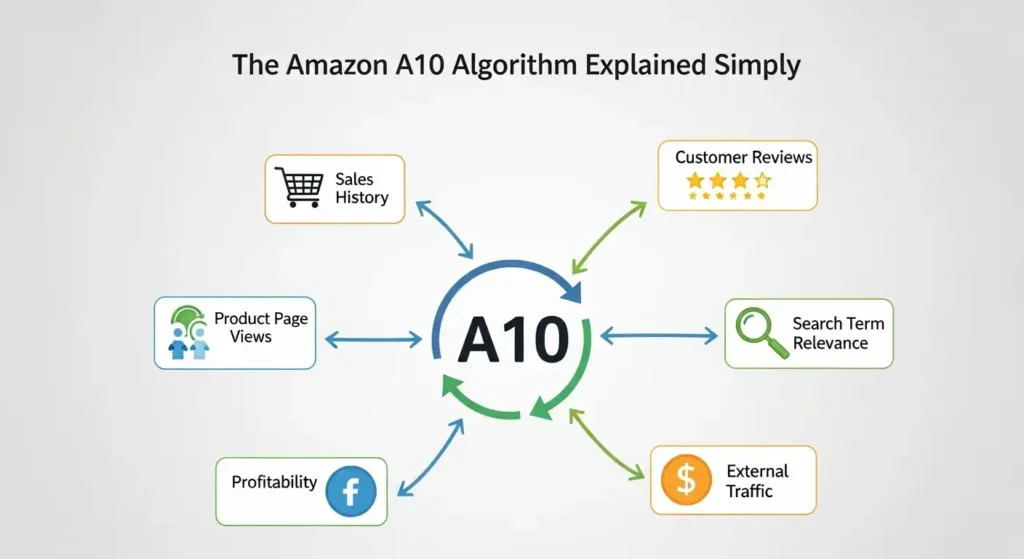
Amazon doesn’t officially name its algorithms, but the seller community identified major ranking changes that represented a shift from the older “A9” system to what’s now called “A10.”
The core principle: A10 ranks products Amazon believes will create the best customer experience and generate the most revenue, not just immediate sales.
Relevance + Performance = Ranking
Every ranking decision follows this two-part evaluation:
Relevance: Does your product match what the searcher wants?
Performance: Do customers who see your listing actually buy it and stay satisfied?
Neither alone is sufficient. Perfect relevance with poor performance keeps you buried. Strong performance without relevance means you never get shown for the right searches.
The Three-Layer Ranking Logic
Rankings happen in stages:
Layer 1 – Indexing: Amazon identifies which keywords your listing should appear for based on your title, bullets, description, and backend terms.
Layer 2 – Relevance Scoring: The algorithm evaluates how well your content matches searcher intent using AI-powered semantic analysis.
Layer 3 – Performance Validation: Amazon tests your listing with small audiences and measures engagement, conversion, and satisfaction before expanding visibility.
Products that pass all three layers consistently get sustained organic visibility. Products that fail any layer get suppressed regardless of their strengths elsewhere.
What Changed from A9 to A10
A9 rewarded: Sales velocity above everything, keyword density, heavy PPC spending, and internal Amazon metrics only.
A10 rewards: Organic engagement over paid traffic, external brand signals, conversion quality over quantity, seller authority, and reliability.
The shift means you can’t buy your way to top rankings anymore. Sustainable visibility requires building genuine customer preference and brand trust.
Keyword Relevance Still Matters (But Differently)
Keywords haven’t disappeared; they’ve evolved from simple matching to semantic relevance.
Placement Precision Over Density
Where keywords appear matters more than how often they repeat.
Strategic placement priorities:
Title (200 characters): Front-load your primary keyword plus the most compelling benefit. Example: “Wireless Earbuds Bluetooth 5.3 – 48H Playtime with LED Display – Waterproof for Sports”
Bullet points (5 bullets, 255 characters each): Start each bullet with a benefit-driven keyword phrase, then support with details. Don’t repeat the same keywords across bullets.
Backend search terms (249 characters): Use this space for synonyms, alternate spellings, and related terms that don’t fit naturally in visible content. Never repeat terms already used elsewhere.
A+ Content: Include contextual keywords in headers and body copy, but prioritize readability and engagement over keyword insertion.
Natural Language Beats Keyword Stuffing
Amazon’s AI detects unnatural keyword repetition and actively penalizes it.
Bad title: “Wireless Earbuds Bluetooth Earbuds Wireless Headphones Bluetooth 5.3 Earphones Wireless.”
Good title: “Wireless Bluetooth Earbuds 5.3 – 48H Battery with Charging Case – Waterproof Sport Headphones.”
The second version includes relevant keywords naturally while remaining readable when customers scan search results or when Alexa reads it aloud.
Purchase Intent Keywords Convert Best
High search volume doesn’t guarantee sales. Focus on keywords that indicate buying intent, not research intent.
Research intent: “how to choose wireless earbuds” (informational)
Purchase intent: “best wireless earbuds for running” (ready to buy)
Target keywords where searchers have already decided to purchase and just need to choose which product.
Conversion Rate Is the Strongest Ranking Signal
Amazon’s entire business model depends on converting browsers into buyers. The algorithm heavily favors listings that consistently turn clicks into sales.
Why Conversion Rate Dominates Rankings
Across most Amazon categories, average conversion rates range from 10-15%. Products converting at 20%+ receive significant ranking boosts. Products below 8% face active suppression.
The compounding effect: Higher conversion → better rankings → more organic traffic → more sales → even higher conversion (if you maintain quality).
This creates a flywheel where strong converters gain momentum while weak converters struggle to gain any visibility.
Elements That Drive Conversion
Professional imagery (7+ images): Main image showing product clearly, lifestyle images demonstrating use, infographic images highlighting features, size comparison images, packaging images, and detail shots of key components.
Video (30-60 seconds): Product demonstration showing real usage, comparison to inferior alternatives, answers to top 3 customer questions, captions for mobile viewers watching muted.
Benefit-focused bullets: Each bullet answers “what’s in it for me?” rather than just listing specifications. Connect features to outcomes customers care about.
Competitive pricing: Your price doesn’t need to be the lowest, but it must be justified. If you’re 20% more expensive than alternatives, your listing must clearly communicate why that premium is worth paying.
Trust signals: Reviews with images, verified purchase badges, Amazon’s Choice designation, brand credibility markers.
Engagement Metrics That Predict Conversion
Amazon tracks behaviors that indicate purchase likelihood:
Add-to-cart rate: How many visitors add your product to their cart (even if they don’t buy immediately)
Wishlist additions: Shows strong interest in future purchase
Comparison clicks: Being added to comparison tools shows serious consideration
Return-to-listing: Customers who view your listing, browse competitors, then return to yours demonstrate preference
All these signals feed into Amazon’s prediction model about which listings convert best.
Struggling with low conversion rates despite good traffic? Schedule a conversion optimization consultation to identify exactly what’s driving customers away from your listing.
External Traffic & Brand Authority on Amazon
This represents the most dramatic shift in Amazon SEO over the past two years.
Why External Traffic Now Impacts Rankings
Amazon realized sellers could manipulate internal metrics through various tactics, but external validation from Google, social media, and authentic content creators is harder to fake.
The algorithm now treats external traffic as a trust signal. If people find your product through Google searches, Instagram posts, YouTube reviews, or TikTok mentions and then purchase on Amazon, the algorithm interprets this as genuine market demand.
Traffic Sources: Amazon Rewards
Google organic search: Customers searching for your product category on Google, finding your brand, and coming to Amazon to buy signal strong brand awareness.
Social media platforms: TikTok, Instagram, Facebook, and Pinterest referrals that result in purchases validate authentic customer interest.
YouTube content: Product reviews, comparisons, and tutorials from real creators build authority that Amazon recognizes.
Influencer partnerships: Genuine partnerships (not fake reviews) that drive qualified traffic demonstrate market validation.
Blog content and PR: Editorial mentions in reputable publications or industry blogs create lasting traffic sources.
Amazon Attribution Dashboard Integration
Amazon’s Attribution tool now feeds external traffic data directly into organic ranking calculations.
When external sessions convert above your category median, you receive ranking boosts proportional to that traffic quality. This means a brand driving 100 high-converting visits from Instagram can outrank a brand generating 1,000 low-converting visits from generic PPC.
Building Brand Authority Beyond Amazon
Sustainable Amazon success in 2026 requires building presence outside Amazon:
Create valuable content answering customer questions in your niche. Engage authentically on platforms where your customers spend time. Partner with creators who genuinely use and recommend your products. Invest in SEO for your brand name so customers find you through multiple channels.
This off-Amazon investment directly improves your Amazon rankings while reducing dependence on the platform’s advertising costs.
Customer Experience Signals That Impact Rankings
Amazon prioritizes sellers who consistently deliver positive customer experiences because unhappy customers cost Amazon money through returns, refunds, and lost trust.
Seller Performance Metrics
Your Account Health dashboard contains metrics that directly affect organic visibility:
Order Defect Rate (ODR): Target below 1%. Anything above 1% triggers visibility suppression. Above 2% risks suspension.
Pre-fulfillment cancel rate: Keep under 2.5%. Frequent cancellations signal unreliable inventory management.
Late shipment rate: FBA sellers automatically maintain good metrics here. FBM sellers must ship on time 97%+ of the time.
Valid tracking rate: Above 95% for FBM sellers. Missing tracking information hurts rankings and customer trust.
Review Quality and Velocity
Amazon’s AI now analyzes review content, not just star ratings.
What the algorithm evaluates:
Review sentiment: Positive language about durability, quality, value, and performance boost rankings. Complaints about defects, sizing issues, or misleading descriptions trigger suppression.
Review recency: Recent reviews carry more weight than old ones. A product with 500 reviews from 2023 ranks worse than a product with 200 reviews from the past 90 days.
Verified purchase ratio: Reviews from verified purchases count significantly more than unverified ones.
Review helpfulness: Reviews with images, detailed experiences, and helpful votes indicate genuine customer satisfaction.
Return Rate Impact
High return rates devastate rankings more severely in 2026 than ever before.
Amazon tracks return reasons. Returns marked “not as described,” “defective,” or “poor quality” hurt far more than returns marked “changed mind” or “bought by mistake.”
Preventing return-driven ranking drops:
Ensure product descriptions and images accurately represent what customers receive. Address common concerns proactively in your listing. Use sizing charts and specification details to prevent mismatched expectations. Maintain consistent product quality through supplier management.
Climate Pledge Friendly and Sustainability
Amazon has begun factoring sustainability credentials into rankings, especially in categories where customers actively filter for eco-friendly products.
Products with Climate Pledge Friendly badges, ethical sourcing certifications, or minimal packaging receive modest ranking boosts when customers use sustainability filters.
Where this matters most: Home goods, personal care, food and beverages, office supplies, and electronics, where eco-conscious consumers actively seek sustainable options.
How to Optimize Amazon Listings for 2026
Knowing what ranks products is useless without clear implementation steps. Here’s your optimization framework.
Title Optimization for AI and Humans
Your title must satisfy both Amazon’s AI and human shoppers scanning search results.
Structure that works: [Primary Keyword] – [Key Differentiator] – [Specific Use Case] – [Top Feature]
Example: “Bamboo Cutting Board Set – 3 Sizes with Juice Groove – Kitchen Prep for Meat & Vegetables – Eco-Friendly & Dishwasher Safe”
Avoid: Generic descriptors, ALL CAPS, special characters, promotional language, redundant keywords.
Bullet Point Framework
Each of your five bullets should serve a specific purpose:
Bullet 1: Primary benefit addressing the main customer problem
Bullet 2: Key differentiator from competitors
Bullet 3: Specific use cases or applications
Bullet 4: Quality/durability/materials information
Bullet 5: What’s included and satisfaction guarantee
Format each bullet: Start with a benefit-driven header (2-5 words) in bold, then 1-2 sentences of supporting detail.
A+ Content That Increases Dwell Time
A+ Content now directly influences search rankings, not just conversion rates.
High-performing A+ Content includes:
Comparison modules: Show how your product stacks up against generic alternatives (never name competitors)
Feature callouts: Visual modules highlighting 3-5 key benefits with icons and short descriptions
Use case scenarios: Multiple lifestyle images showing your product in different situations
Size/compatibility charts: Help customers choose the right option without leaving your listing
Brand story (keep brief): One module explaining your brand’s unique value proposition
Backend Optimization Details
Search terms field (249 characters): Include synonyms, alternate spellings, related terms, and long-tail variations. Separate with spaces, no punctuation. Never repeat terms used in visible content.
Product category selection: Choose the most specific, accurate Leaf Node category. Wrong categorization suppresses listings even with perfect SEO.
Product attributes: Fill every relevant attribute field (material, color, size, compatibility). Amazon uses this data to power filters and recommendations.
Image Requirements for 2026
Main image: Product only on white background, professional quality, fills 85% of frame, minimum 1000px (2000px+ recommended for zoom)
Images 2-3: Lifestyle shots showing product in real-world use
Images 4-5: Infographics highlighting key features and benefits
Images 6-7: Size comparisons, what’s included, detail shots
Video (critical): 30-60 seconds showing product use, addressing common questions, with captions for mobile viewers
Mobile-First Optimization
With 70%+ of Amazon searches happening on mobile, your listing must perform perfectly on small screens.
Mobile optimization checklist:
Images load quickly on slow connections. Titles are concise enough to display fully on mobile. Bullets are scannable, not walls of text. A+ Content displays correctly on smartphones. Videos autoplay with captions (many watch muted).
Why Seller Goals’ Approach Works Better
Most Amazon agencies optimize listings the same way everyone else does, checking boxes on a standard SEO checklist and hoping for results.
We built something different.
Our Authority-First Methodology
We don’t start with keywords. We start by establishing why Amazon should trust your brand more than your competitors.
The SellerGoals optimization framework:
Phase 1 – Authority Audit: We identify your current authority signals (external traffic, brand searches, content presence) and find gaps competitors haven’t filled.
Phase 2 – Conversion Foundation: We optimize every element for maximum conversion before pursuing traffic. Rankings mean nothing if visitors don’t buy.
Phase 3 – Semantic Optimization: We structure content using AI-friendly formats that help Amazon’s algorithm understand your product comprehensively.
Phase 4 – External Validation: We create sustainable external traffic sources that compound your Amazon authority over time.
Why This Approach Outperforms Standard SEO
Standard SEO says: “Find keywords, insert them in your listing, run some ads, hope for rankings.”
Our approach says: “Build genuine brand authority that Amazon’s AI recognizes as trustworthy, create listings that convert at exceptional rates, establish external validation that proves market demand, then leverage all of this for sustainable organic visibility.”
The difference shows in the results. Our clients don’t just rank, they maintain rankings while reducing ad dependence and improving profit margins.
Real Results from Authority-First Optimization
One health supplement brand came to us ranking on page 3 for their main keyword despite running aggressive PPC campaigns.
What we changed:
- Restructured listing for semantic clarity (not just keyword insertion)
- Created a YouTube content strategy, driving qualified external traffic
- Optimized for conversion first, traffic second
- Built authority signals Amazon’s algorithm rewards
Results in 90 days:
- Main keyword: Page 3 → Position 2
- Organic traffic: +340%
- Conversion rate: 11% → 18%
- PPC dependency: Reduced ad spend 45% while maintaining sales
- Revenue: +156% with improved margins
Standard SEO couldn’t deliver this because standard SEO doesn’t address what Amazon actually prioritizes in 2026.
Ready to see what authority-first optimization can do for your brand? Book your free strategy session with our Amazon SEO specialists.
The Ranking Timeline You Need to Understand
Setting realistic expectations prevents premature strategy abandonment.
Indexing Happens Fast, Ranking Takes Time
Indexing (24-48 hours): Amazon recognizes your keywords and begins showing your listing for relevant searches, usually starting on page 20+.
Initial testing (Week 1-3): Amazon shows your listing to small, relevant audiences and measures their response. Rankings fluctuate wildly during this phase.
Performance validation (Week 4-8): If test audiences engage and convert well, Amazon gradually expands your visibility. If they bounce or don’t buy, visibility decreases.
Ranking stabilization (Week 9-16): Consistent performance leads to stable rankings. Inconsistent performance creates ongoing volatility.
Competition Level Affects Timeline
Low-competition keywords: 4-8 weeks to page 1 with proper optimization
Medium-competition keywords: 8-16 weeks to top 3 pages
High-competition keywords: 4-8 months for page 1 (if achievable at all)
What Accelerates Rankings
External traffic from day one validates demand signals faster. Exceptional conversion rates (well above category average) boost Amazon’s confidence in promoting your listing. Consistent review generation demonstrates ongoing customer satisfaction. FBA fulfillment eliminates fulfillment concerns. Existing brand authority compounds new product launches.
Common Optimization Mistakes That Tank Rankings
Even sellers who understand 2026’s algorithm make these critical errors.
Mistake #1: Optimizing for Keywords Instead of Intent
Stuffing your target keyword everywhere while ignoring what customers actually want to know.
The fix: Write content that comprehensively addresses customer questions, concerns, and use cases. Keywords should appear naturally within helpful content, not as the primary focus.
Mistake #2: Ignoring Engagement Metrics
Focusing solely on clicks and conversions while overlooking dwell time, scroll depth, and engagement signals.
The fix: Create A+ Content designed to keep visitors engaged. Include comparison charts, detailed use cases, FAQ sections, and visual storytelling that encourages scrolling.
Mistake #3: Neglecting Inventory Distribution
Sending all inventory to one fulfillment center, losing the Shipment Proximity Index benefits.
The fix: Use Multi-Node Inbound placement to distribute inventory across regions. The ranking boost often outweighs slightly higher fulfillment costs.
Mistake #4: Mobile Optimization Afterthought
Designing listings for desktop and hoping they work on mobile.
The fix: Design mobile-first. Test every element on actual smartphones. If something doesn’t display well or load quickly on mobile, fix it immediately.
Mistake #5: Pure PPC Dependency
Relying exclusively on paid ads without building organic authority.
The fix: Use PPC for initial momentum while simultaneously investing in listing quality, external traffic, and brand building. The goal is reducing ad dependency over time, not increase it.
Your Next Steps Toward Higher Rankings
Understanding Amazon SEO in 2026 is just the beginning. Implementation determines results.
Start here:
Audit your current listings against 2026’s ranking factors. Identify the biggest gaps between your current optimization and what the algorithm rewards. Prioritize conversion optimization before pursuing more traffic. Build external traffic sources that validate your brand authority. Monitor engagement metrics, not just sales data.
Remember: Sustainable Amazon success comes from building genuine brand authority and customer preference, not from gaming an algorithm that’s too sophisticated to manipulate.
The sellers winning in 2026 aren’t using tricks. They’re building real businesses that Amazon’s AI recognizes as valuable to customers.
That’s exactly what we help brands achieve at SellerGoals.
Work With Amazon SEO Specialists Who Get Results
Stop guessing what works and start implementing proven strategies that align with how Amazon actually ranks products in 2026.
Our team specializes in:
- Authority-first optimization that builds sustainable visibility
- Conversion-focused listing development that turns traffic into sales
- External traffic strategies that validate brand demand
- AI-friendly content structure that helps algorithms understand your products
- Performance monitoring and continuous optimization
- We don’t just optimize your listings, we build the foundation for long-term Amazon success.
Get Your Free Amazon SEO Performance Analysis
We’ll review your top 3 products and show you:
Your current ranking performance vs. category leaders
Specific optimization gaps are costing you visibility and sales
Quick wins you can implement this week for immediate improvement
A custom 90-day roadmap to page 1 rankings
This analysis normally costs $500. It’s free for the next 10 brands.
Claim Your Free SEO Analysis Now
Or talk directly with our Amazon SEO specialists about your specific challenges.
Book Your Free Strategy Call
The algorithm keeps evolving. Your optimization needs to evolve with it. Let us show you what’s possible when you optimize for authority, not just keywords.
Your next customer is searching Amazon right now. Make sure they find you.
Frequently Asked Questions
What is Amazon SEO in 2026?
Amazon SEO is optimizing product listings to rank higher in Amazon search results by aligning with the A10 algorithm’s ranking factors. In 2026, this means focusing on conversion rate, customer engagement, external traffic validation, and natural language optimization over traditional keyword stuffing.
What ranking factors matter most on Amazon in 2026?
The most critical factors are conversion rate (percentage of visitors who buy), customer engagement metrics (dwell time, scroll depth), external traffic that converts, seller performance metrics (ODR, shipping performance), review quality and recency, and inventory distribution across fulfillment centers.
How long does it take to rank on Amazon in 2026?
Low-competition keywords can reach page 1 in 4-8 weeks with proper optimization. Medium-competition keywords typically take 8-16 weeks. High-competition keywords may require 4-8 months of sustained optimization, external traffic, and strong performance metrics to achieve top rankings.
Does external traffic really affect Amazon rankings?
Yes, significantly. Amazon’s algorithm now treats external traffic from Google, social media, and content creators as validation of genuine market demand. External sessions that convert above category median rates trigger ranking boosts proportional to traffic quality and conversion performance.
How important is conversion rate for Amazon SEO?
Conversion rate is the single strongest ranking signal. Products converting at 20%+ receive significant ranking advantages over competitors converting at 10-15%. Amazon prioritizes listings that turn clicks into sales because this directly impacts their revenue and customer satisfaction.
Author’s Note: Amazon SEO strategies based on documented algorithm changes through January 2026 and analysis of ranking patterns across thousands of products. Amazon doesn’t publicly disclose algorithm specifics, so strategies reflect observed best practices. Test approaches with your specific products and categories.